
SHENZHEN, China, Sept. 7, 2026 /PRNewswire/ — A news report from Shenzhen Daily:
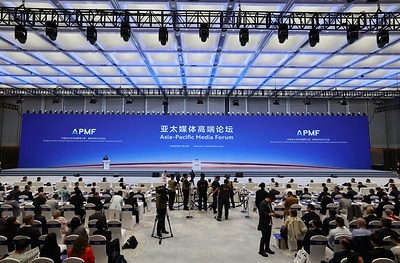
The Asia-Pacific Media Forum opens in Shenzhen, Guangdong, China on Sept. 5. Photo by He Long and Lai Li from Shenzhen Special Zone Daily.
For years, conversations about media transformation centered on platforms, distribution channels and traffic. Artificial intelligence has changed the terms of that debate. It can generate content faster and at lower cost, translate it into multiple languages, and adapt it for different platforms in seconds.
For traditional news organizations, the question is no longer whether AI will enter the newsroom. It is where human journalists can continue to create irreplaceable value — and how they can actively reshape their work.
That question was put to media professionals attending the Asia-Pacific Media Forum, which opened in Shenzhen, Guangdong, China on Sept. 5 under the theme “Building a Path to Shared Prosperity for the Asia-Pacific Community: Media Consensus and Action.” More than 400 representatives from over 40 countries and regions, as well as U.N. agencies and international organizations, attended the event.
Their answers revealed neither blind optimism nor simple fear.
Zahir Shah Sherazi, head of BOL News in Pakistan, acknowledged that AI can drive innovation and make reporting easier, but stressed that it cannot genuinely tell audiences what is happening without journalists on the ground.
“You still need physical presence to put in emotions,…Machines cannot replace humans,” he said. Rather than fearing the technology, he believes journalists should receive training and become well versed in AI-assisted reporting.
Donovan Ralph Martin, CEO and editor-in-chief of Canadian outlet The Daily Scrum News, described himself as a strong advocate for AI. News organizations that fail to use the technology, he warned, risk being left behind.
Yet enthusiasm must come with a clear understanding of AI’s limitations. It “is as good as the people using it,” Martin said, adding that human interaction will remain essential to journalism.
AI may accelerate production, but it cannot independently decide which questions matter, recognize what is left unsaid, or take responsibility for the consequences of publication.
Adaptation, according to Muhammad Ashraf, editor-in-chief of Pakistan’s Daily Mashriq Lahore, is no longer optional.
“Change is the only permanent thing in the world,” Ashraf said. “So accept the challenge of change, and go with it.”
That requires more than purchasing new tools. Journalists must learn about AI, adopt it and keep pace with its development. Newsrooms also need to help reporters understand how the technology works, where it can fail and when its output must be questioned — without handing over their editorial judgment.
Nang Calyar Win, CEO of Myanmar’s Asian Fame Media Group, offered a useful metaphor: “AI is like a reflection of everybody.”
She said that a knowledgeable user can obtain stronger results, while limited knowledge and weak instructions can produce weak output.
“The AI depends on the user,” Win said. The smarter the tool becomes, the more capable the journalist using it must be.
In an environment flooded with synthetic content, the value of professional media may increasingly lie in verified facts, first-hand observation, cultural understanding and accountability.
The real choice, then, is not between humans and machines. It is between journalism that uses AI responsibly and content production that allows automation to operate without judgment.
As the forum’s theme suggests, consensus must lead to action. Newsrooms should share technology and experience, establish clear verification standards, and train journalists to use AI without surrendering the human qualities on which trust depends.
To counter the challenge, Shenzhen Daily and Daily Kasoti, a Pakistani media outlet, quickly signed a memorandum of understanding on content production cooperation less than 24 hours on Sept. 4, ahead of the Asia-Pacific Media Forum.
The Shenzhen’s daily English newspaper and information platform have leveraged the forum to reach several agreements with media outlets from Canada, Pakistan, Russia and Myanmar.
ข่าวที่เกี่ยวข้อง
- Hohem Expands into Sam’s Club with iSteady V3 Ultra AI Tracking Gimbal
- Fios Genomics bioinformatics team and services move to Excelra
- ทีมงานและบริการชีวสารสนเทศศาสตร์ของ Fios Genomics ได้ย้ายไปรวมกับ Excelra เป็นที่เรียบร้อยแล้ว
- Natural Field to Showcase Liposomal Delivery and Formulation Solutions at SupplySide Global 2026
